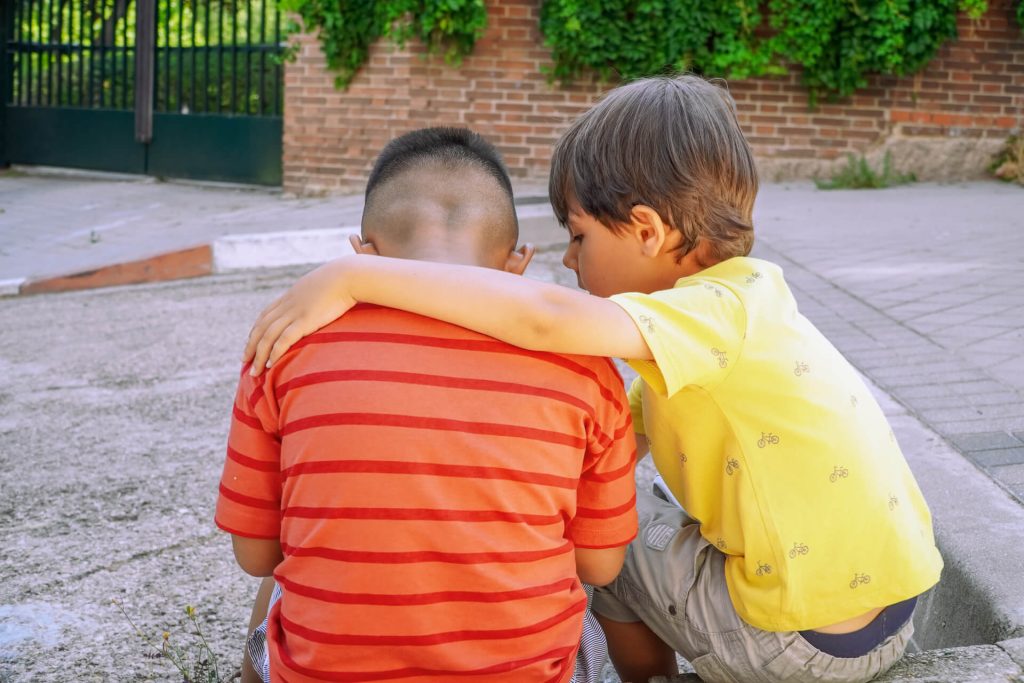


Are you one of those lucky parents whose child runs into the arms of everyone on the playground, who is adored by the whole nursery – from the children to the nursery teacher, the dinner lady and the cleaner, who entertains the entire paediatric waiting room with their little songs and jokes, and who, thanks to their chattiness and love of nattering with the staff at the bakery, often gets a free bun or a pretzel thrown in?
These are the children everyone says things like: “We don’t worry about them, they’ll find their feet”, “Lucky you, isn’t she confident and outgoing!” or “Just look at him chatting away like a grown-up, not a shy bone in his body – he’ll go far!” If you don’t recognise yourself in these lines, this article is just for you.
It’s nicer in company
Every parent would surely rather have a sociable child than one who withdraws into themselves and avoids social interaction. My son is one of those children who spotted the benefits of open communication very early on. When I’d take him out for a walk, he’d pop into the neighbourhood salon just to say hello to the hairdressers, and they’d reward him with a smile, a kind word and a sweet. When we got on the bus, he’d ask the driver not only the price of the ticket but also: “Mister, how much does this whole bus cost?”, and on the playground he’d find himself a playmate in no time flat by walking up to whatever child happened to be there and asking: “Do you want to play with me?” Because he always wants to help and because the other children recognise him as a leader in team games, he always has friends to go outside with.
But some children are naturally more inclined to have better developed social intelligence, to pick up more easily on how social situations work and to find their way in them with less effort. Can this be worked on, and how? What steps can we take on this parenting journey of ours, as we try to turn our little ones into good people and bright minds? How do we help them embrace this value too? You could say that constant exposure to all kinds of social situations, along with encouragement and reassurance, is a recipe for success.
What does social intelligence involve?
What do we even call intelligence? Mental qualities made up of several different abilities and skills: adapting to new situations, learning from experience, using previous knowledge, understanding abstract concepts, finding your way in unfamiliar environments and unfamiliar circumstances…
This is how scientists arrived at various classifications, some of which distinguish types of intelligence such as: linguistic, logical-mathematical, musical, visual-spatial, emotional, social and others.
Social intelligence is a special kind of intelligence, encompassing several interconnected abilities such as: emotional sensitivity, social analytical skill, good self-control, sociability, tolerance and social adaptability.
Natural inclination and encouraged development of social intelligence
It’s often the case that in families with more than one child, not all the children have equal social skills even though their parents brought them up in almost identical ways. Some children are more extroverted, others more introverted. Some children shy away from leaving their comfort zone.
None of us is a perfect parent, but there is something we can do for our children – we can equip them with skills that will help them move through life more easily, and developing social intelligence is something that can be of great benefit to them in every sphere of life. At school, at university, at work, in everyday situations, in interpersonal relationships, in romantic relationships, adequately developed social skills can only bring positive results.
How to encourage the development of social intelligence in your child?
What if you’ve noticed that your child isn’t exactly the best at making new friendships, can’t show empathy, can’t express their wishes and needs, is reluctant to join their peers in play, won’t share toys, avoids talking to adults, answers questions shyly and in monosyllables, and feels uncomfortable at the mere thought of any kind of public performance?
Does your child get overwhelmed by fear and nerves when they have to speak in front of a group of children or adults (a neighbour, a relative, family friends, a nursery teacher, a coach)? You’ve noticed that your child has trouble asking a question, requesting something they want, shies away from taking part in the school show even though they love to sing, dance and recite poems? They’d rather be bored or play on their own than ask that famous question to a child they don’t know in the little park: “Do you want to play with me?”
Don’t worry, there are certain steps you can take on the path towards your child embracing this value too.
- Children learn by example, by imitating our behaviour. Talk clearly, freely, kindly and assertively, while respecting the person you’re speaking to.
Your child is aware of the communication that goes on within your home, but they also notice whether you say hello to the neighbours in the lift and whether you chat with them. Your child hears your phone conversations too. They notice how you speak to the shop assistant at the till, to the nursery teacher when you come to pick them up, how you talk to grandparents, what your manner is like towards other children, the woman at the bank or post office, the person begging on the street, the ticket inspector on the train, and so on.
Show what kindness, empathy and effective communication look like in your relationships with family members, friends and others. Teach them how to listen carefully to others, how to understand and respect their feelings. Demonstrate how to express your thoughts and needs clearly and kindly.
- Read stories to your child and then talk about what you’ve read. Play at stepping into different roles.
Stories featuring different characters and situations can be an excellent way for children to learn about interpersonal relationships. Discuss the characters’ actions and the feelings they experienced.
Stepping into roles can be particularly useful for children who feel insecure in social situations, giving them a safe space to practise and develop their social skills while learning about virtues and responsibilities in society.
- Encourage communication. Listen actively when your child speaks and encourage them to express themselves. This not only develops their communication skills but also reinforces the importance of open dialogue in relationships.
Phone calls with close family members can also be useful for “practising” confidence in communication. Teach them to talk on the phone – let them call grandma or grandpa. This task helps a child try out social skills in different contexts and develop the ability to communicate clearly and kindly.
- Team games and activities: little sports, music ensembles, choirs, dance groups, workshops
Taking part in team sports or group projects helps children develop cooperation and conflict-resolution skills. Enable your child to attend as many activities as possible that offer opportunities for socialising.
- Let your child be independent in line with their age
Sending your child to the shop can be an excellent way to encourage their independence and responsibility. For example, you can give your child a list of a few items to buy. This gives them the chance to practise decision-making, problem-solving, managing money and interacting with shop staff. This kind of activity also builds your child’s confidence, because they see that you trust them to complete a task on their own. If your child is younger or going to the shop alone for the first time, you can wait outside or nearby so they feel safer.
- Praise positive behaviour
When a child shows empathy, kindness or good communication, parents should praise and reward them, which encourages that behaviour to be repeated.
To sum up
Encourage independence that suits their age. Letting children make decisions and solve problems on their own builds their confidence and social skills. Expose your child to situations in which they need to talk and join in with their peers.
Through developing social intelligence, a child gains the ability to understand and articulate their feelings and to manage them, as well as to communicate effectively and resolve conflicts with others. So, although a child may have a natural talent for social interaction, anyone can improve their social skills through learning and experience. An environment that supports the development of social skills can help a child grow into a socially intelligent person, and that is one of the most precious gifts we can give our children for the future.